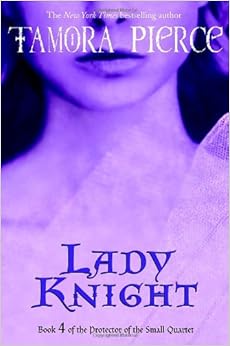
I feel bad about marking this as unfinished. I had started reading right before my mess of migraines hit, and when I picked it up afterwards, I couldn't remember anything that had happened in the story.
When it comes right down to it, my interest in this book wasn't high to begin with. I do like the world that was created but I never found the story itself particularly engaging. It was enough to make me want to keep going, but nothing I would rave about or even recommend to someone. When it got to the point where I couldn't remember what happened the last time I had picked up the book, I decided it wasn't the worth the effort of trying to figure it out.
Book reviews every week of fantasy, romance, fairy tales, and whatever other books I happen to have lying around.
Showing posts with label fantasy. Show all posts
Tuesday, August 4, 2015
Tuesday, May 19, 2015
Lady Knight
Wow. I've been gone for a while, haven't I? I apologize. I've been having medical issues. Let's pick things back up with a familiar series.
Total shocker, right? What the heck happened? Well, part of it might be due to the fact that I was battling daily migraines at the time I was attempting to read this. But the other part of it, quite honestly, is that the plot of this book just kind of sits there.
Kel is knighted and given her first assignment at a refugee camp, an assignment she isn't happy about. She's been having visions about the mastermind behind the killing machines that have been roaming the country, and she'd much rather be battling them and bringing the man responsible in. Though, the camp itself has it's own issues that she has to navigate.
We begin the book on this premise. Over half way through the book, we are still on this premise. Kel is still at the camp, she is still having visions, she is still wishing there was more she could do. The plot has not moved forward in the slightest. I skimmed the majority of this book, and then finally gave up.
I was faced with the prospect that the plot might not pick up until the final chapters of the book, and that just wasn't worth waiting for. I'd read enough about Kel and her issues at the camp. I was ready to move forward into the "real" struggle and had no indication of when that would happen or if it could even turn my opinion of the book around when it did.
Perhaps it's an unfair rating given the personal struggles I was facing at the time. But I just got to the point where I need to call quits.
Monday, January 26, 2015
Goblin Hero
This was a bit of a disappointment from the previous book. We still have Jig and all his wonderfulness. He also has a great new set of companions. But the book divides itself, going back and forth between Jig and new goblin, named Veka, who also wants to be a hero, and she... leaves something to be desired.
I'm hoping the third and final book might redeem Veka's character a little, but this might turn out to be another series where only the first book is worth reading.
Monday, January 12, 2015
Squire
As Kel ages, each book in the series ages, making each one better than the last.
In this book, Kel is undergoing her final training and test before she will finally becoming the first female knight in a decade. Kel even finds love in this book, and I have to admit the relationship surprised me and I was uncertain at first of Kel's true feelings on the matter. All of Kel's previous relations and struggles and are expanded upon here, creating a more and more enjoyable read.
Monday, January 5, 2015
Goblin Quest
Goblin Quest is a beautiful parody of every Dungeons & Dragons adventuring party. If you haven't played any table top RPGs or enjoy epic-fantasy adventuring novels, than the point of this novel is going to be lost on you. On the other hand, if you have...
Jig is the hero of this tale, and though he'd much rather find a nice hole to hide in, it's Jig who is often the voice of reason among the adventuring party. And he saves their lives on more than one occasion, much to the chagrin of the arrogant prince.
Part of what made this book such a joy was reading it aloud in the car to my husband and having him laugh along with me. That and the sheer humor in this book made it a joy to read.
Thursday, December 11, 2014
The Night Circus
The Night Circus, is essentially a story of two real-magic magicians who are pitied against each other against their will to a battle to the death. What makes the story so intriguing is the circus itself and how the lives of these two characters intertwine with other people in the circus.
My main issue with this story is how the chapters are not written in chronological order. From one aspect, this echos the mysterious feel the circus itself holds. But from another, it adds confusion for the reader. Especially when certain chapters take place years after the time of the chapters surrounding it.
For example, we are introduced to a character named Bailey, whose chapter, is placed between other chapters that take place years before he's even born. At first, I was thrown off, wondering who this Bailey was when he didn't connect with any other characters I'd been introduced to at that point. Then, I started to like Bailey, and I wanted to read more of him. And then chapter after chapter passes without mention of him. We finally do catch up with him in the proper time line. But then why take one chapter and set it so far off? Why not have his whole story fit more chronologically so I'm not thrown off when I first meet him and I get to continue to read about him when I grow attached to him? The placement of that first chapter makes no sense to me.
It's possible the author was trying to create a certain feeling of suspense or foreshadow by mixing up the chronological order of the chapters, but sometimes even this fails. There's several references in the book of a blinding light that will mean something bad for the circus. As we're following a character who is trying to figure out what happened, we are jumped into the past in a chapter that reveals some of what happened or at least gives the reader enough information to guess, all the before the character we are following figures it out. Why ruin the suspense like that?
There are certain readers, I think, who respond well to such a mixed way of telling. But I was thrown off so many times (not just by the order of chapters, but how some chapters begin in such a way that you have no idea what is going on in relation to what you just read), that I didn't care much for it. I think I would have liked this story a lot better if the chapters had been in order according to their time line.
The other thing that really annoyed me was the complete lack of relationship development between the two main characters. They have one meeting full of electric charge between the two of them - a terrible romance clique, even if it is real in the case of these two - and then the narrative jumps three years and they are desperately in love with each other. We don't get to see their love develop at all. We're just supposed to accept it. And I felt cheated for not getting to see the love grow between them.
Now, I did listen to this story on audio CD, and I had a friend point out that the mixed chronology is less jarring in print. However, what really bugs me is I just can't justify why the chronology is mixed. I don't see the reason behind it. And I really can't get over how glossed over the love story was. Even if I did like the print version better, the issues I take with how the story was told and the love story in particular would still probably bring the book to three stars. I did enjoy the characters, and I did enjoy the circus. But the love story is such an important part of the plot and with the story's structure being so mismatched ... I don't feel loving the circus and the characters can make up for that. I'm sure for the right reader, this book would be perfectly enchanting.
Thursday, December 4, 2014
Page
Given the mixed reviews I read about this book, I wasn't sure what I'd think of it. Those who didn't like the book cited the jarring lapses of time as the short book crams in a number of years and the odd plot of Keladry's maid. It was a pleasant surprise to find I liked this book even better than the first.
While the first book mainly focused on Keladry's training and the question of whether she'd be able to keep up with the boys physically and if the training master would allow her stay even if she did prove herself, this book starts to go into deeper issues. There's a lot of corruption in the world, and it starts to come to light through the story of Kel's maid, the summer excursion that nearly kills Kel and her classmates, and hints of war coming in future years. We also get some of Kel's personal issues as she starts to notice boys and they start to notice her. All in all, this book was just way more interesting and engaging. The odd passage of time didn't bother me at all.
I still give this book three stars simply because I'm waiting for something more exciting to happen. This book still mainly circles around Kel's training with hints at how the plot is going to pick up in later books. I'm excited to keep moving forward with the series and see how the struggle started in this book lead into the others.
Thursday, November 27, 2014
Sister Light, Sister Dark
This book has consistent 5-star ratings on Goodreads, so I feel a little bad for not enjoying it as much.

The world is certainly imaginative. The women of Alta hames have the power to call forth their dark sisters from the other side of the mirror, sisters who are them and not them at the same time. Learning the culture of the hame was a large draw of the book for me. I got into it, and I enjoyed being in that world.
What I didn't like is how the book is divided up into sections - Legend, Myth, History, Song, Ballad ... These sections add little, if anything, to the story itself and mostly served to pull me out of the narrative. I didn't care about the historical analysis of the Alta women from 700 years in the future. I didn't care about a song written about the events I had just read. I didn't care about a legend that foretold what I was about to read. I just wanted to read the story without being interrupted by extraneous information.
After a couple chapters I just skipped over the extra sections, making an already short book (about 200 pages) even shorter, which brings me to the second thing that annoyed me a little. This is the first book in a two-book story that could have easily been combined into one. Not only is the book short, but it has the same issue I felt with Star of the Morning, which is this book by itself does not tell a complete story. The plot really only picks up at the end with what really should be the middle of the book or just before it.
This first book, really is just set up for the next one, and I just take issues with stories that are published like this. One book, should tell one complete story, in my opinion. It can have lose ends. Questions can be left unanswered. But there needs to be a rising action, climax, falling action, and resolution. This book doesn't have that. It's all just rising action. And that bothers me.
So, it gets three stars because I found the book itself to be lacking. But I do plan on continuing on to the next book.
Monday, November 17, 2014
First Test
This is the first book in Tamora Pierce's Protector of the Small series. This is also the first book of Tamora Pierce's that I have read. Looking at her other series, this is the one that interested me the most, so I picked it up. This series follows the story of Keladry, or Kel for short, who is the first girl admitted to training to become a knight since the King's proclamation that girls could do so. Kel has one year to prove she can keep up with the boys or else she'll be sent home.
I read this book within a day. It's short - about 200 hundred pages. And there's no real overarching plot - the story mostly just goes through Kel's training as the year progresses. What makes it much more interesting than say the training in Gwenhwyfar: The White Spirit is it's not just details of the children's chores for the day. We get Kel's thoughts and emotions as she tries and sometimes fails and sometimes succeeds at the tasks. We get the slow progression of friendships Kel forms with her fellow students. We get the back and forth sense of uncertainty from the training master - is he for or against Kel?
For such a simple book, there's a lot of emotion packed into it. You are driven to care about the characters and what happens as the year moves on. I had no desire to put the book until I was through to the end. Kel herself is very likable, befriending animals and protecting her smaller classmates (Kel is tall for her age). She's smart and capable, though at times uncertain. And she has a fear of heights.
I liked this book, and I'll definitely be picking up the rest of the series.
Thursday, November 13, 2014
The Mage's Daughter
And we are back with the second book in the first trilogy of Lynn Kurland's The Nine Kingdoms series. As we return, this book focuses primarily on Morgan and Miach. Morgan is as stubborn and willful as ever, though a little unsure of herself given the evens of the previous book and with Miach's affections continuing to catch her off guard.
I'm very excited to move on to the final book in the trilogy. I expect it to have plenty of action with magic and sword play, and danger and romance of course. I can't wait!
Finally, in this book the plot picks up. Morgan's true identity is realized, the danger to the kingdom is identified, and Morgan and Miach's relationship is eventually solidified. There's still magic and swordplay going on, though not as much as the previous novel. Primarily this book focuses on Morgan and Miach's relationship. And me, being a lover of romance, ate it up. Unlike the previous novel, this does seem to have a solid beginning and ending - mainly the relationship arc - and I feel like I could go back and read it on its own if I wanted, though reading the first book prior to is still required to give this one context.
I'm very excited to move on to the final book in the trilogy. I expect it to have plenty of action with magic and sword play, and danger and romance of course. I can't wait!
Monday, November 3, 2014
Poison Study
Okay, so I'm throwing out the idea of reviewing series as sets unless I have reason to otherwise. Ha. Next up, we have Poison Study by Maria V. Snyder. I've been thinking lately about how a lot of books have pointless prologues or just have poor beginning chapters that don't offer much substance and their books take too long to get to the point. This book, however, is awesome in that we are dumped right into the action.
This novel suffers from an identity crisis. Since the characters are in a castle and there's no electricity, I would think the setting is going for middle ages (and the cover helps with that). There's also mention of period appropriate clothing. But there are modern influences that pop up that shouldn't. For one, not even the most prestigious castle would have running hot water. Technology would not be advanced enough for switchblades or trampolines. I'm not sure "disinfectant" would have been a word. "Military district" would not have been shorted to "MD" in conversation or conscious thought. Yelena wouldn't bathe everyday. And even though this is a fantasy kingdom with it's own customs, animals, people, and countries, coffee somehow exists. This book doesn't know if it wants to be medieval, it's own fantasy realm, or modern.
There's some not so well constructed story elements. Yelena is given a poison that she needs a daily antidote to for the rest of her life or she'll die. I might be willing to believe Yelena doesn't realize poisons don't work like that, but you're telling me no one out of the multiple people Yelena goes to for help don't know poisons don't work like that? There's no possible way Valek could have switched out a poisoned bottle of wine with a clean one. He'd have to have the second bottle close by, for one. And since the wine is from a country they don't import with, it'd be impossible. And there's no way a master chief wouldn't have thought of roasting some mystery beans to change their flavor, especially not when Yelena asked if they were coffee beans, which he's been craving for years.
Transitions are severely lacking between paragraphs. For example: In one sentence Yelena is talking with Lisa, then paragraph break and Yelena is with the Camander. Yes, I know Yelena was on her way to the Camander and she caught Lisa on the way there. I can figure that out, but you need to tell me that Yelena moved from Lisa's side and continued on her way so I don't sit there and go "wait-wha?" in the moment. This kind of thing happens throughout the book.
The author needs to give more description in certain instances. At one point Yelena gets out a grappling hook and "climbs through the trees." How? How is this working with the grappling hook? How is she moving from tree to tree? You need to describe it to me. When Yelena and the love interest finally kiss, it's glossed over so quickly, the meaning that's supposed to be attached to it went right over my head. More description was needed here and in other places.
Yes, this novel has issues. It makes me sad to think these are all things a good editor could have caught and worked with the author to correct. When you look at it all written up, the damage would seem pretty major. Yet, I've always said that if a story is good, I can overlook almost any other issues. And this book proves to follow that rule. Despite everything, I got caught up in the story. I couldn't put the book down. And when I finished with it, I immediately wanted the next one.
We meet Yelena as she is about to go to her execution for killing a general's son. The Comander's poison taster (this is a kingdom controlled by the military) has recently died, and as per the Code of Conduct, the position must be offered to those facing execution (I guess since no one but someone already facing their death would be crazy enough to take the job). Yelena accepts, and finds herself in a position where her life is threatened every bit as much as before.
This novel suffers from an identity crisis. Since the characters are in a castle and there's no electricity, I would think the setting is going for middle ages (and the cover helps with that). There's also mention of period appropriate clothing. But there are modern influences that pop up that shouldn't. For one, not even the most prestigious castle would have running hot water. Technology would not be advanced enough for switchblades or trampolines. I'm not sure "disinfectant" would have been a word. "Military district" would not have been shorted to "MD" in conversation or conscious thought. Yelena wouldn't bathe everyday. And even though this is a fantasy kingdom with it's own customs, animals, people, and countries, coffee somehow exists. This book doesn't know if it wants to be medieval, it's own fantasy realm, or modern.
There's some not so well constructed story elements. Yelena is given a poison that she needs a daily antidote to for the rest of her life or she'll die. I might be willing to believe Yelena doesn't realize poisons don't work like that, but you're telling me no one out of the multiple people Yelena goes to for help don't know poisons don't work like that? There's no possible way Valek could have switched out a poisoned bottle of wine with a clean one. He'd have to have the second bottle close by, for one. And since the wine is from a country they don't import with, it'd be impossible. And there's no way a master chief wouldn't have thought of roasting some mystery beans to change their flavor, especially not when Yelena asked if they were coffee beans, which he's been craving for years.
Transitions are severely lacking between paragraphs. For example: In one sentence Yelena is talking with Lisa, then paragraph break and Yelena is with the Camander. Yes, I know Yelena was on her way to the Camander and she caught Lisa on the way there. I can figure that out, but you need to tell me that Yelena moved from Lisa's side and continued on her way so I don't sit there and go "wait-wha?" in the moment. This kind of thing happens throughout the book.
The author needs to give more description in certain instances. At one point Yelena gets out a grappling hook and "climbs through the trees." How? How is this working with the grappling hook? How is she moving from tree to tree? You need to describe it to me. When Yelena and the love interest finally kiss, it's glossed over so quickly, the meaning that's supposed to be attached to it went right over my head. More description was needed here and in other places.
Yes, this novel has issues. It makes me sad to think these are all things a good editor could have caught and worked with the author to correct. When you look at it all written up, the damage would seem pretty major. Yet, I've always said that if a story is good, I can overlook almost any other issues. And this book proves to follow that rule. Despite everything, I got caught up in the story. I couldn't put the book down. And when I finished with it, I immediately wanted the next one.
Monday, October 20, 2014
Gwenhwyfar: The White Spirit
The synopsis of this book is extremely misleading. You'd think the Gwen in the novel is the Guinevere who becomes Arthur's wife, but she's not. In fact, the novel opens just before Arthur's wedding. The protagonist of the novel is a girl who shares Guinevere's name and who lives on the very outskirts of Arthur's kingdom. In fact, she mentions they are so far on the outskirts that anything Arthur does would barely cause a ripple for her and her family.
Yet, the pacing of the book is slow. By chapter six, I still had no idea why we were following this not-Guinevere around. We learn about her sisters, none of which she is particularly attached to, and her desire to be a warrior, which is fulfilled as she undergoes training. And training itself is nothing particularly interesting either.
If I'd had this in book form instead of audio CD, I would have been skimming over the pages in the hopes to getting to something more substantial. As it was, I kept listening to the book for background noise, not because I had any further interest in it. A third of the way through the book is when the plot finally gets moving. And even then, it's in such a sinister way as to make me certain that not only would I not enjoy this book but I'd be frustrated and angry until the final pages.
I've read Mercedes Lackey before and enjoyed her work. I thought I was going to like this, and I really wanted to. The detail she puts into the world is admirable, and from what I've read from other reviews of this story, she goes into some of the less favorable tales of Arthur - the killing of all the May born babies in an effort to kill Mordred, the switching out of Guinevere for a fake one so that Mordred can have the real one...
I think it's clear that Lackey set out to do something specific with the book, and I applaud her efforts. It's possible she even succeeded at what she had hoped to do, but this book - with it's slow pacing and what I'm sure was to be an utterly depressing plot - isn't for me.
The book is interesting to a certain extent. You can tell Lackey really did her research on this one as she goes into great detail involving the goings on of the castle, the clothing, the decor, etc. The religious aspects are interesting to. Part of me wanted to continue with the story just so I could fully understand this world Lackey had put together.
Yet, the pacing of the book is slow. By chapter six, I still had no idea why we were following this not-Guinevere around. We learn about her sisters, none of which she is particularly attached to, and her desire to be a warrior, which is fulfilled as she undergoes training. And training itself is nothing particularly interesting either.
If I'd had this in book form instead of audio CD, I would have been skimming over the pages in the hopes to getting to something more substantial. As it was, I kept listening to the book for background noise, not because I had any further interest in it. A third of the way through the book is when the plot finally gets moving. And even then, it's in such a sinister way as to make me certain that not only would I not enjoy this book but I'd be frustrated and angry until the final pages.
I've read Mercedes Lackey before and enjoyed her work. I thought I was going to like this, and I really wanted to. The detail she puts into the world is admirable, and from what I've read from other reviews of this story, she goes into some of the less favorable tales of Arthur - the killing of all the May born babies in an effort to kill Mordred, the switching out of Guinevere for a fake one so that Mordred can have the real one...
I think it's clear that Lackey set out to do something specific with the book, and I applaud her efforts. It's possible she even succeeded at what she had hoped to do, but this book - with it's slow pacing and what I'm sure was to be an utterly depressing plot - isn't for me.
Monday, October 13, 2014
Star of the Morning
The Nine Kingdoms series by Lynn Kurland consist of three trilogies. We'll be looking at the first one, which follows the story of Morgan, a willful and stubborn sword hand, and her mage-love, Miach. Some readers encounter this series and are turned off my Morgan's attitude, finding her whiny. I liked her.
I'm always impressed when an author can write something that sounds boring - a long journey from one end of the country to the other - and make it exciting. Really, that's what this novel entails, just one long journey from the first few chapters to the last. And yet there's plenty of danger, swords, magic, and some flirtations to keep the reader entertained. The characters themselves are likable and enjoyable to read about.
And yet, in the form of a story ... there isn't much here. There's the beginnings of a romance. Morgan's identity has only begun to be understood. There's still no telling where exactly the dangers of the kingdom are coming from. And the novel just ends with the journey finished but no real resolution to anything. It's an enjoyable enough of a read, but on it's own it feels incomplete and leaves something to be desired. That said, I connected with the characters and the plot enough to want to continue the series.
Monday, October 6, 2014
Howl's Moving Castle
I've seen the movie, Howl's Moving Castle, a number of times. I found it enchanting, even if certain elements seemed a little unclear. I have to say that if you've seen the movie and liked it, even a little, then you should read the book. It's better.
Sophie is the eldest sister of three, and believes she will never amount to anything. She works as a hat maker in a shop run by her step mother. One day, the Witch of the Waste arrives and curses Sophie into an old woman. Unable to explain her curse, Sophie flees town. She finds herself on the doorstep of the evil wizard Howl's castle. Taking on as Howl's cleaning lady, Sophie uncovers the wizard's true nature and works to break his own curse as well as his contract with a fire demon.
The book is every bit, if not more so enchanting than the movie. The building of the world, the characters, and the magic is simply wonderful and immediately sucks you in. Things only started to slow down for me when the real world was introduced. I felt it broke some of the magic going on. And how Howl came from this ordinary world into this magical world to be one of the most powerful wizards isn't explained.
The ending of the novel also seems to happen very suddenly. It's not clear when exactly Howl turns his attentions to Sophie, nor is it clear when Sophie stops believing she can't achieve anything grand in life. The change happens subconsciously for Sophie and she mistakes it on Howl, making it easy for the reader to miss since the novel is told from Sophie's point of view. I think a re-read could fix this and might soften the blow I felt from the introduction of the real world as well.
All in all, I liked the novel very much. I don't feel I could call it one of my favorites without giving it a second read, but I'd pretty much recommend it to anyone who likes fantasy or has seen the movie to give it a try.
Thursday, October 2, 2014
Once Upon a Marigold
Once Upon a Marigold is a cutesy, pun-filled, predictable book. For the right person, that's all you need to know to never pick it up. For the first two chapters, I wasn't sure where the book was going. Even once we got to the main plot, I wasn't sure this book was something I would continue with.
What did keep me going were the characters. They aren't cardboard cutouts and are surprisingly well rounded for a book of this nature. I really got to enjoy hanging out with them, and they carried me through the book.
That said, this book is the first in a trilogy. And while I would say I liked this book, I can't say that I liked it enough to pick up the others. These just aren't the right kind of books for me.
Subscribe to:
Posts (Atom)